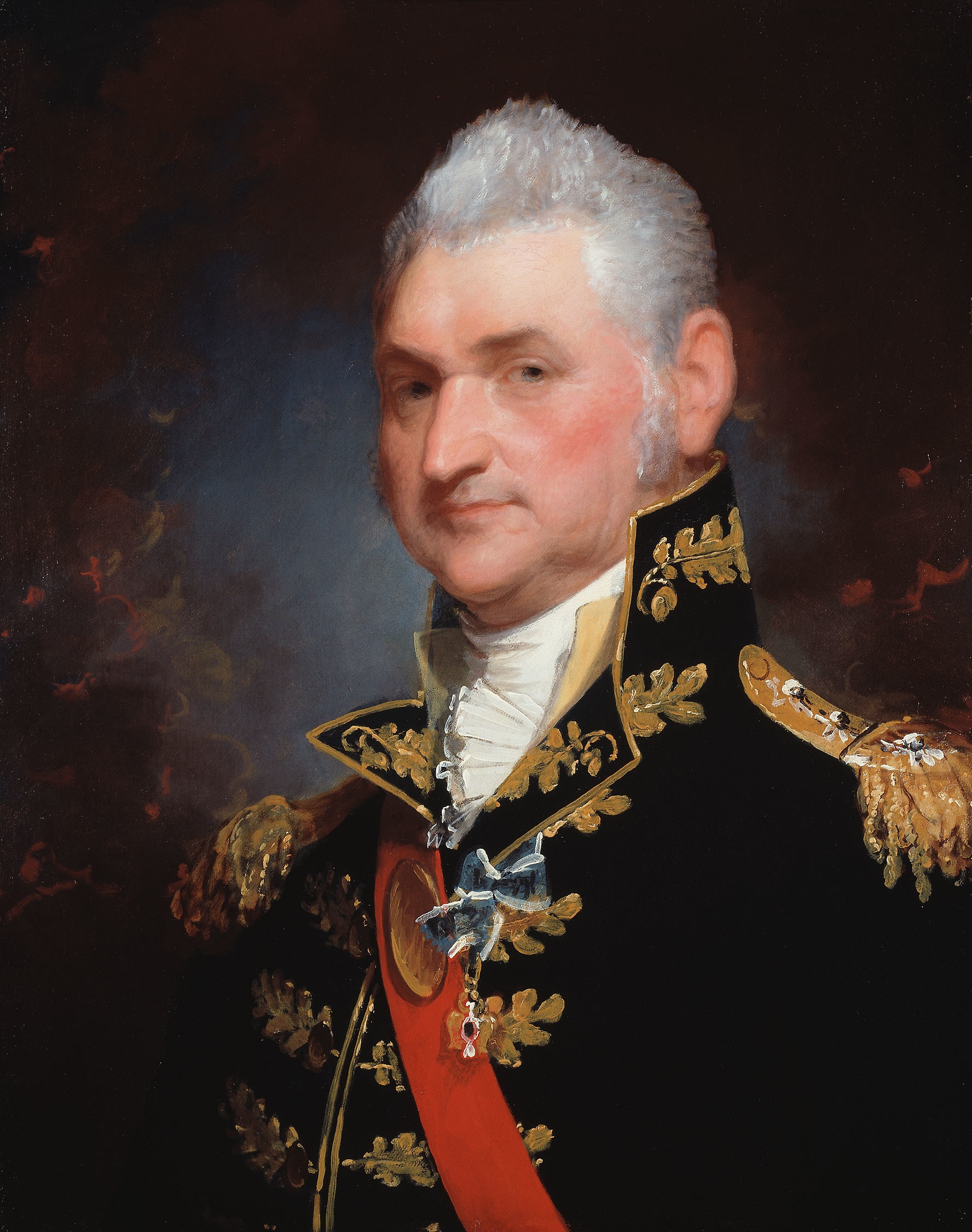
Henry Dearborn was born on February 23, 1751 in North Hampton, New Hampshire to Simon Dearborn and Sarah Marston. He attended public schools in Epping, New Hampshire and then studied medicine under Dr. Hall Jackson of Portsmouth before opening his own practice in Nottingham, New Hampshire in 1772. During the Revolutionary War, Henry Dearborn served the Continental Army as a Captain, rising in rank to Lt. Colonel, in the 1st and 3rd New Hampshire Regiments. He was twenty-three when he organized and led a local militia of sixty men to the Boston area where he fought in the Battle of Bunker Hill. He was with Benedict Arnold in the ill-fated expedition to Quebec where he, and other officers, were captured in the Battle of Quebec and held for a year, being part of an exchange in March of 1777. He went on to fight at Ticonderoga, the Saratoga campaign, and the Battle of Monmouth. In 1781, he was appointed Deputy Quartermaster General and was a member of George Washington’s staff in Virginia and was present when Cornwallis surrendered at Yorktown. In 1783, after being discharged from the army, Dearborn moved to Maine where he became Major General of the Maine militia and George Washington appointed him marshal of the District of Maine. Later, Dearborn served in the House of Representatives for Maine from 1793 to 1797. In 1801, Thomas Jefferson appointed Dearborn as the Secretary of War, an office that he held for eight years. He reentered the military as a Major General at the beginning of the War of 1812 at the request of then President James Madison, but after failures with the invasion of Canada, the loss of Ft. Niagara, and the loss of control of Lake Ontario, he was transferred to Boston and kept in administration for the rest of the war. Afterward, he stirred controversy when he accused, the long deceased, Israel Putnam, his Commander at Bunker Hill, of cowardice and incompetence during the British attack. However, because Putnam was enshrined as a hero of the Revolution, Dearborn’s version of the story failed to do the damage he wanted. Instead, it damaged his own reputation and ended his political ambitions. He ran for Governor of Massachusetts and lost, then was renominated to the Cabinet, but was rejected. His last official position was Minister to Portugal which he served from 1822-1824. After returning home, he retired from public service. Henry Dearborn married three times: first to Mary Bartlett in 1771, to Dorcas Osgood Marble in 1780, and to Sarah Bowdoin in 1813. He had three children. He died in Roxbury, Massachusetts on June 6, 1829. Lewis and Clark named the Dearborn River in Montana after him, as were Dearborn County Indiana; Dearborn, Michigan; and Dearborn, Missouri.