Deprecated: Creation of dynamic property CleanUrl\Router\Http\RegexPage::$priority is deprecated in /home/voiceso2/public_html/vendor/laminas/laminas-router/src/SimpleRouteStack.php on line 285
Deprecated: Creation of dynamic property CleanUrl\Router\Http\CleanRoute::$priority is deprecated in /home/voiceso2/public_html/vendor/laminas/laminas-router/src/SimpleRouteStack.php on line 285 Items · Voices of the Eastern Shore · Voices of the Eastern ShoreSkip to main content
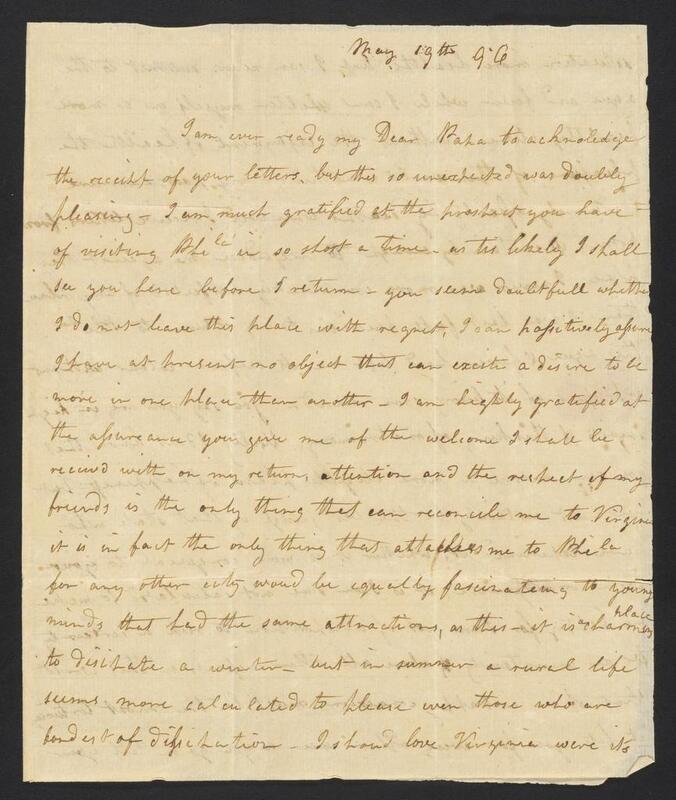
Letter from Ann Upshur Eyre to her step-father, John Upshur of Brownsville, written while Ann attended boarding school in Philadelphia. The letter discusses family news, health issues and upcoming nuptials for John Upshur.<br /><br />
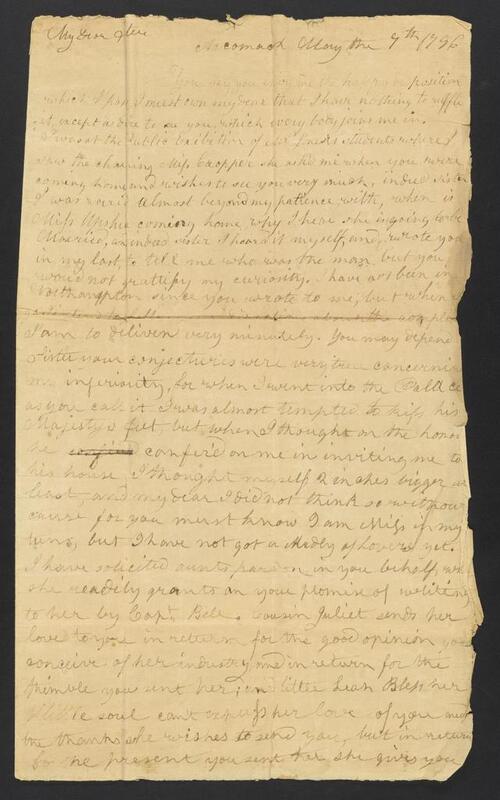
Letter from Elizabeth Upshur Teackle to her sister Ann Upshur Eyre while Ann attended boarding school in Philadelphia with Mrs. Valeria Fullerton. The letter touches on family news, their Upshur cousins Leah and Juliet, and other family acquaintances.<br /><br />
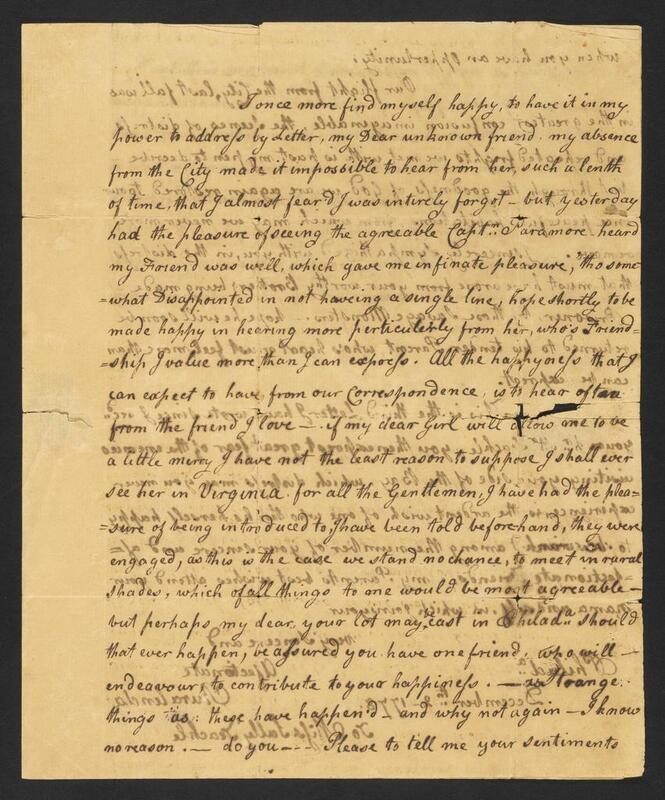
Letter from Nancy Cunningham to Sarah “Sally” Teackle Kendall describing her flight from Philadelphia during the Revolutionary War, and also contains updates about Teackle's brother Severn Teackle who is imprisoned by the British on a ship anchored off Long Island. Severn Teackle is the Grandfather of Severn Teackle Wallis. Attached to this letter is a note dated 1829 written by Elizabeth Upshur Teackle explaining how she came to be in possession of this letter from her Great Aunt Sally Teackle Kendall.<br /><br />
<p id="OTPS32150442P0">Anne Milbourn married William Andrews on January 12, 1802, in Somerset County, Maryland. Research continues for this person.
</p>
<p id="OTPS32150204P0">Jane Grant Gilmor was born on March 31, 1801 in Baltimore, Maryland to William Gilmor and Mary Ann Smith. She married Gen. Benjamin Chew Howard and together they had twelve children, most of which lived past infancy. Jane Howard was known throughout Baltimore for her charitable work and was made the president of the Great Southern Relief Association in 1865 which held a fair in Baltimore that raised almost $200,000 for those who had lost everything in the Civil War. She wrote a cookbook to raise money for charity, under the name Mrs. B. C. Howard, titled “Fifty Years in a Maryland Kitchen” which was published in 1873. The Howards were known enslavers, with Gen. Benjamin Chew Howard being listed among the U.S. Representatives who were slaveholders (Washington Post, 2022.) Jane Howard died at the age of 89 in Baltimore, Maryland and is buried at Green Mount Cemetery.
</p>
<p id="OTPS32353048P0">Catherine Teackle Neale Upshur was born in Richmond, the daughter of William Neale and Elizabeth Teackle Smith Neale. She's buried at Christ Episcopal Church Cemetery in Eastville, Virginia.
</p>
<p id="OTPSD32219121P0">In 1664, Arthur Upshur was granted the patent for 2,000 acres of land on the Eastern Shore of Virginia that he named Upshur’s Neck. Warwick, the house he built and named after the English birthplace of his wife, Mary, was completed around 1670. Surrounded by a grove of ancient trees, including southern hackberries, the house overlooks Upshur’s Bay and Virginia’s Ocean Islands can be seen from the property. The house is a story and a half with a gable-roof porch and is considered characteristic of Eastern Shore Architecture with a long, wide entry hall, large parlor with a carved mantle, a large dining room for entertaining guests, and an ascending staircase along the side at the end of the hall. John Eyre bequeathed the house to Elizabeth Ann Upshur Teackle Quinby, his wife Ann Matilda Upshur Eyre’s niece, after his death.The Upshur descendants owned the house until 1912, when it was sold.
</p>
<p id="OTPSD32278311P0">Myrtle Grove is a historic home situated on the north bank of Goldsborough Creek, south of Goldsborough Neck Road and northwest of Easton. The house faces to the southwest and consists of three sections: a frame section that dates to the beginning of the 1700's, a brick section from 1790, and a frame wing from 1927. The Goldsborough family came to Maryland in the late 1600's and Robert Goldsborough settled in Talbot County, where he served the community as Justice of the Peace and Chief Justice of the Court. His son, Robert Goldsborough II was the first to live in Myrtle Grove, which he built in 1734, on a part of the Ashby estate.
</p>
<p id="OTPSD32282078P0">Sappho, or Psappha in her native Aeolic dialect, was born sometime around 630 to 620 BCE, to an aristocratic family on the island of Lesbos, which is just off the coast of Anatolia, or modern-day Turkey. She had at least three brothers, Erigyius, Larichus and Charaxus, and a daughter named Cleis. Sappho was a lyric poet whose work was so loved for its beauty and passion that that statuary, coinage, and pottery were created in her honor for centuries after her death. While it is uncertain whether she was homosexual or not, Sappho’s poetry held a decided romantic interest in women through the poetic persona of her writing. Thus, she is the inspiration for the words “lesbian” and “sapphic” since the eighteenth century to describe homosexual women. Sappho wrote an estimated 10,000 lines of poetry, however only 650 of them have survived, to include the only complete poem extant: Ode to Aphrodite.
</p>
<p id="OTPSD32282069P0"><hi rend="italics">The Odyssey</hi> is an ancient Greek epic poem attributed to Homer, chronicling the ten-year journey of King Odysseus as he tries to return home after the Trojan War, facing mythical creatures and divine challenges.
</p>
<p id="OTPSD32318488P0">Marmion: A Tale of Flodden Field is a poem by Sir Walter Scott, published in 1808. It consists of six cantos and concludes with the Battle of Flodden, which occurred in 1513 between England and Scotland in Northumberland.
</p>
<p id="OTPSD32282094P0"><hi rend="italics">Brittain's Ida</hi>, a mythological erotic poem, was published about 30 years after Edmund Spenser's death in 1628, and was misattributed to him, although written by Phineas Fletcher.
</p>
<p id="OTPSD32281721P0">Venus is the Roman goddess of love, beauty, desire, sex, fertility, prosperity, and victory. She is considered to have been born from the seafoam, and is the counterpart of the Greek Aphrodite, though she had no real mythical background until then. In Roman mythology, she is considered the ancestor of the Roman people through her son, Aeneas (Read: Virgil's Aeneid) and Julius Caesar claimed her as a direct ancestor. Her symbols were roses, myrtle, copper, the color blue, and the number five. Her Festivals were: the Veneralia on April 1st, the Vinalia urbana on April 23rd, the Vinalia Rustica on August 19th, and Venus Genetrix on September 26th.
</p>
<p id="OTPSD32282092P0">Terra, or Tellus, was the goddess and personification of the the Earth, as well as earthquakes, fertility, nature, marriage, and agriculture. Her Greek counterpart was Gaia. She is one of the primordial goddesses, like Nyx, and came fully formed from Chaos. She is depicted as a woman holding a cornucopia filled with the fruits of nature and agriculture. Her Festivals are the Sementivae in January, which is shared with Ceres, and the Fordicidia, which is celebrated on April 15th.
</p>
<p id="OTPSD32334810P0">Psyche was a mortal princess who was so beautiful that people began bringing her offerings as if she were Venus, making the goddess angry enough to send Cupid to make the girl fall in love with a beast. Instead, Cupid fell in love with her and stole her away and married her, but Psyche broke an oath to him and had to survive three trials to gain forgiveness from Venus before she was allowed to speak to Cupid again. Once forgiven, she was gifted with immortality and is considered the goddess of the soul. She is often represented as a beautiful girl with butterfly wings. The story of Cupid and Psyche is in Apuleius' 2nd century CE novel: Metamorphoses or The Golden Ass.
</p>
<p id="OTPSD32282089P0">Neptune was the Roman god of the seas, fresh waters, storms, winds, and horses. Like his Greek counterpart, Poseidon, Neptune was the brother of Jupiter and Pluto, and the son of Saturn and Ops. His symbols are the trident, the dolphin, and the horse. His Festival, the Neptunalia, was celebrated at the peak of summer on July 23rd, during the hottest and driest time of the year.
</p>
<p id="OTPSD32281776P0">Minerva was the Roman goddess of wisdom, strategic warfare, the arts, craftsmen, justice, and law. She was most likely originally the Etruscan goddess, Menrva, and she is also equated to the Greek goddess, Athena, with a similar origin story of being born as a grown, armored woman with a spear, out of Jupiter's head. She is the third deity in the Capitoline Triad, the most powerful gods of Rome, along with Jupiter Optimus Maximus and Juno Regina. Her symbols are the owl, the helmet and spear, the olive tree, and the spindle. Her Festival was the Quinquatria, which was celebrated from March 19 through March 23.
</p>